

compliance

ATO’s 2026 Compliance Program

The ATO has had a couple of programs running over the past few years targeting Australia’s wealthiest private groups.  They kicked off with the Top 500 program and are now well into the Next 5000 Program – which targets private groups with wealth of more than $50 million.

You may be asking what this has to do with me?  Whilst the focus of these programs is high wealth groups, they also set the expectations that the ATO now applies across all businesses – including small and medium enterprises.

If you run a family business, trade through multiple entities, use trusts, or are planning a sale or restructure, the themes coming out of these programs are a useful playbook. They show what the ATO regards as “high risk”, what it will ask for in an engagement, and where you can remove risk before a review starts.

The ATO’s emerging focus areas, and how they affect you

  1. STRONGER TAX GOVERNANCE IS EXPECTED
  • What the ATO wants: documented tax governance procedures, clear decision‑making records, up‑to‑date trust resolutions, and timely lodgements and payments.
  1. EVERYDAY COMPLIANCE MISTAKES ARE RED FLAGS
  • Common mistakes: undocumented shareholder/related‑party loans, missed Division 7A repayments, GST errors, missed FBT, wrong CGT treatment and trust distribution/UPE issues.  These are easy for the ATO to spot and expensive to fix. Fix the basics first — correct paperwork beats firefighting later.
  1. MAJOR TRANSACTIONS TRIGGER SCRUTINY
  • Transactions watched closely: business sales, restructures, refinancing, property purchases/transfers and internal restructures.  Expect questions on valuations, tax treatment, CGT reporting and GST classification when you transact.
  1. GST REVIEWS ARE BECOMING ROUTINE
  • What the ATO looks at: GST‑free vs input‑taxed supplies, related‑party recharges, export treatments, construction/property transactions and input tax credit substantiation.  The ATO’s 12‑month detailed GST approach used in larger reviews is filtering down — accurate GST treatment and strong supporting records are essential.
  1. PROPERTY AND CONSTRUCTION REMAIN A HOTSPOT
  • Key concerns: property development within groups, SMSF participation in projects, trading stock vs capital asset classification and profit allocation across entities.  If you’re in property or construction, the ATO expects commercial terms, arm’s‑length pricing and defensible documentation.

What ATO compliance measures mean for your business

If your SME:

  • uses a trust
  • pays directors/shareholders instead of wages
  • owns property
  • has related‑party loans
  • has cross‑border dealings
  • is planning a restructure, sale, or refinance.

…these ATO focus areas apply directly. Strong governance and documentation now will put you in a better position if the ATO reviews your affairs.

Employer obligations

In addition to the above points, Superannuation will be a major focus in 2026/27.  With the introduction of Payday Super from 1 July 2026, the ATO will be focused on ensuring employers are paying their SGC each payday rather than quarterly.  The Single Touch Payroll (STP) gives the ATO  visibility over business payrolls and makes it easier for them to track late or unpaid super and PAYG withholding.

Key compliance areas – individuals

The key compliance areas for individual taxpayers and wage earners focuses heavily on record-keeping, work-related expenses, and rental property deductions.   With automated data-matching, the ATO identifies discrepancies in individual and business tax returns almost immediately.

  • Work-Related Expenses: Cracking down on unsubstantiated or inflated deductions (e.g., car, clothing, and home office claims).
  • Rental Properties: Scrutinizing excessive deductions, interest claims, and private use of holiday homes.
  • Omitted Income: Data-matching with banks, share registries, and digital platforms to ensure all side-hustle, cryptocurrency, and share income is reported

How Activ8 can help

We focus on practical, commercial solutions, not unnecessary complexity. We help SMEs with:

  • Tax governance frameworks for SMEs
  • Division 7A, trusts & UPE compliance
  • ATO review readiness & audit support
  • GST & FBT risk reviews
  • Support for major transactions
  • Ongoing advisory & strategic planning.

Ready to strengthen your tax position? If you want peace of mind, are planning a transaction, or need help preparing for ATO engagement, we can help you reduce risk and build a stronger tax governance foundation.


surcharge

Surcharging Changes

From 1 October 2026, the Reserve Bank of Australia (RBA) will ban surcharges on debit, credit, and prepaid card payments across EFT, POS, Visa, and Mastercard. This means businesses will no longer be able to pass on card processing fees to clients as a separate surcharge at checkout.

The RBA is also slashing the fees your payment provider charges you behind the scenes (interchange fees). That’s designed to offset the ban. But those savings don’t land in your account automatically. Your provider has to actually pass them on, and right now, there’s no guarantee they will.

The new interchange fee caps are lower across the board, and small businesses are getting larger reductions than big retailers. On top of that, from April 2027, the RBA is introducing caps on foreign card transactions (which have historically been much more expensive) and requiring payment providers to publish their fees in a standardised format.

3 Things to Do Before October 2026

Three things to sort out before the surcharging ban kicks in.

  1. Get a full fee breakdown
    Your payment provider probably bundles interchange, scheme fees, and their own margin into one number. Ask them to unbundle it. You want to see the interchange component (what the bank charges), the scheme fee (what Visa or Mastercard charges), and your provider’s margin separately. You need all three to know whether the new caps are actually flowing through to you.
  2. Check the new interchange caps
    Once you can see the interchange component, compare it to the RBA’s new caps. If your provider’s total fee doesn’t drop roughly in line with the interchange reduction, you’re effectively subsidising their margin. That’s your cue to shop around. And with the new transparency rules coming in April 2027, comparing providers is about to get much easier.
  1. Rethink your pricing
    If you’ve been pricing with surcharges baked in, your sticker prices may need adjusting. This isn’t just a compliance change. It’s a pricing conversation. How do your margins hold without the surcharge buffer? Do you need to adjust menu prices, service rates, or quote structures? This is also a great opportunity to take a broader look at your pricing strategy. Many businesses are using this moment to implement small, strategic price increases across their client base.
identification-id

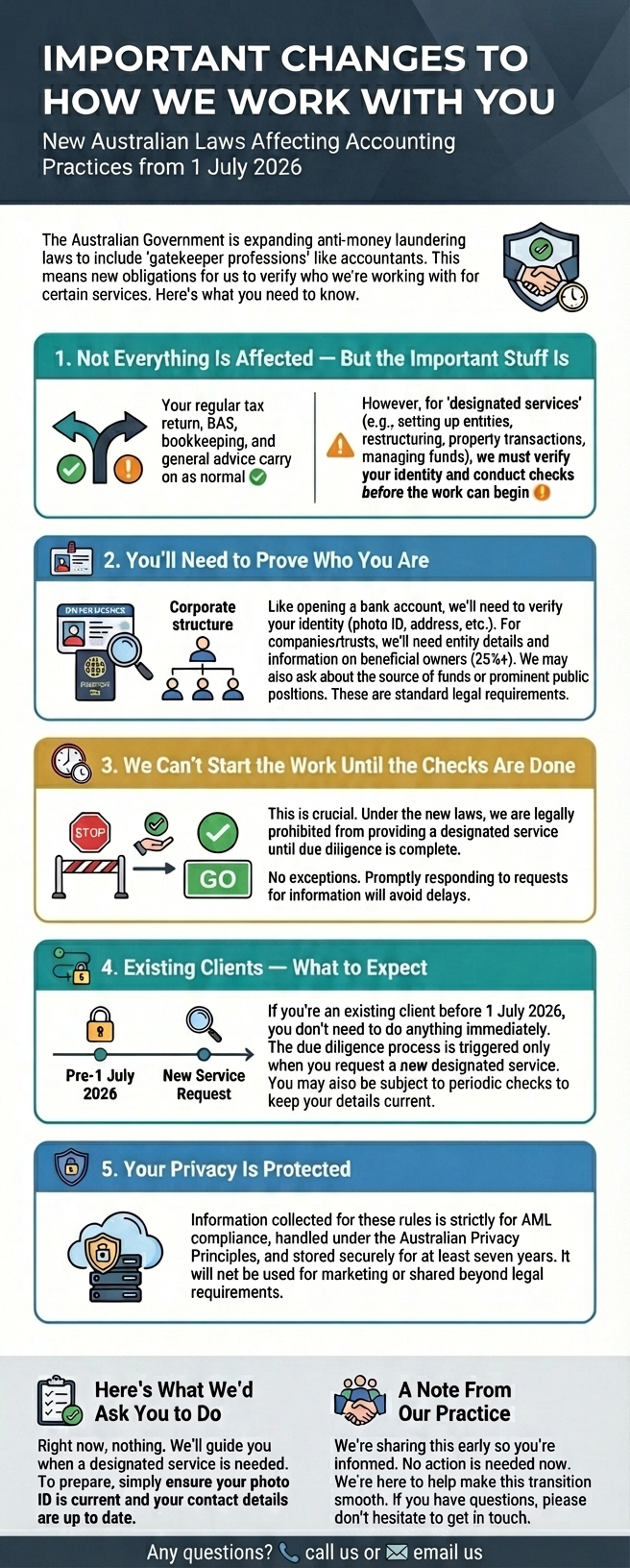
Anti-Money Laundering (AML) measures for accountants

Just to keep us busy, AUSTRAC, the government agency fighting financial crime, decided to make it a legal obligation for accountants who provide services around company setups and registered office services to be regulated.  With financial penalties for non-compliance.

Why now?  Australia is catching up to the global standards, and these laws align us with other developed countries.

What does this mean for you?  For certain work (structuring, registered offices, transactions), we must verify who you are, understand the engagement’s purpose, and assess risk before we can start.

A blanket rule, not a suspicion.  These are standard checks applied to every client across Australia.  It is not triggered by suspicion or because something is wrong.  It is a blanket legal requirement for everyone, ensuring the system’s integrity.

Your information is secure.  We are required to keep records of identity checks and engagement details for at least seven years.  Your information will only be used for compliance with these obligations.  It will not be used for marketing, shared with business partners, or sold to third parties.  It will be handled in accordance with Australian Privacy Principles.

We’ll be in touch.  We’ll reach out to complete the required AML checks, most likely as part of your annual engagement.  We may already have some documents on file, so the process should be quick.  All we ask is that you have a current photo ID ready for each director and beneficial owner, and respond promptly when we get in touch.


Pay-day-super

Payday Super Is Coming: What It Means for Your Business.

In short: Super every payday – not every quarter.

From 1 July 2026, employers will need to pay their employees’ superannuation at the same time as wages, instead of quarterly.

That means every time you run payroll, your employees’ super will also need to be paid into their funds… not three months later.

Same money, just sooner.

This Isn’t a New Expense, It’s a Timing Shift

The amount of super you pay isn’t changing… what IS changing is when you need to pay it.

Right now, businesses have the benefit of:

  • Holding onto the cash for the whole quarter before it’s due, or
  • Building up the funds across three months to pay at the end.

From 1 July 2026, that buffer disappears. You will need to pay super with each pay run instead of quarterly.

There may be short-term cash flow pain, but a little planning goes a long way. Remember in July you will have the quarterly SGC payment due and the new Payday Super amounts.

What’s Actually Changing?

Here’s what the Treasury Laws Amendment (Payday Superannuation) Bill 2025 and related legislation will bring in:

  • Super must be received by the fund within seven business days of payday.
  • “Qualifying earnings” will replace “salary and wages” as the definition of what attracts super.
  • The ATO’s Small Business Superannuation Clearing House (SBSCH) will be decommissioned from 1 July 2026.
  • Super funds will have less time to allocate contributions (down from 20 business days to just 3).
  • The maximum contribution base will move from quarterly to annual.
  • Penalties will tighten: late or missed payments will accrue daily interest, plus administrative penalties.
  • The ATO will use Single Touch Payroll (STP) data to identify non-compliance in real time.

The goal? To close the “super gap” (the billions of dollars in unpaid or delayed super for individuals across Australia) and help employees grow their retirement savings faster.

Our Take …

Payday Super might sound like extra admin, but it’s really a cash-flow shift, not a new cost.

Once you adjust your systems and mindset, it’ll become just another part of your payroll routine, and your employees will benefit from seeing their super grow sooner.

If you’re unsure or need some assistance with payroll setup, reach out.  Activ8 will be more than happy to assist.

budget-breakdown

Budget Breakdown 2026

Don’t restructure anything yet!

It’s been a bit chaotic since Budget night.  Wild headlines and dodgy case studies from reporters.  All this before we have even seen the draft legislation!

While there are some genuinely BIG proposed changes in this Budget, almost none of this is immediate. These are announcements. Many still need to pass Parliament. Some might change significantly. Some might never happen at all.

Here’s our quick breakdown of the major announcements and what actually matters right now.

Working Australians

There are three big announcements aimed squarely at everyday workers.

Income Tax Cuts:  The Government confirmed the next round of personal income tax cuts, aimed mostly at low-to-middle income earners.

From 1 July 2026, the 16% tax bracket drops to 15%. Then to 14% from 1 July 2027.

For taxpayers earning above $45,000, this could mean:

  • Up to $268 extra in your pocket from 2026–27
  • Increasing to around $536 annually from 2027–28

Will this completely change your financial future? Probably not.

The $250 Working Australians Tax Offset: From 2027–28, eligible workers may receive a permanent annual tax offset of up to $250. It’s essentially another little cost-of-living measure designed to slightly reduce the tax burden for working Australians.

The $1,000 Instant Work-Related Deduction: This one might become popular!  From 1 July 2026, workers may be able to claim up to $1,000 in work-related expenses without needing receipts or detailed substantiation.

So yes, the Government may finally be acknowledging that nobody enjoys digging through old email folders looking for a $14 Officeworks receipt from 11 months ago.

People who claim higher deductions can still use the normal rules if it benefits them more.

Small Business

The $20,000 Instant Asset Write-Off Is Becoming Permanent: From 1 July 2026, eligible businesses under $10 million turnover will permanently be able to immediately deduct eligible assets under $20,000.

This is less about creating huge tax savings and more about giving businesses confidence to actually plan ahead.

Loss Carry Back Returns: Loss carry-back rules are also making a comeback. Eligible companies will again be able to offset current-year losses against previously taxed profits to potentially generate cash refunds.

In plain English: if your business had a good year, paid tax, then got smacked by rising costs and tougher trading conditions… this could provide some very welcome cashflow relief.

EV Tax Benefits Are Slowly Driving Off Into The Sunset

The generous EV Fringe Benefits Tax concessions introduced over the past few years are being gradually scaled back.

The full exemption remains until March 2027, but higher-value EVs will start losing some of the tax advantages after that.

Importantly: existing arrangements are expected to be grandfathered. So no — there’s no need to panic-sell your Tesla tomorrow morning.

But if you’re considering:

  • Salary packaging an EV,
  • Entering a novated lease,
  • Or upgrading a fleet…

…timing may become increasingly important over the next couple of years.

Capital Gains Tax

Obviously one of the big-ticket items from the Budget.

From 1 July 2027, the Government is proposing to scrap the 50% Capital Gains Tax discount and replace it with a CPI indexation model plus a 30% minimum tax framework.

And importantly: this isn’t just about residential property.  It pretty much covers all investments.

BUT there are still a LOT of unanswered questions here.

The transitional rules appear to preserve pre-2027 gains, and taxpayers may have options around valuations and formulas. But the actual mechanics still need serious clarification.

What we do know is this: if passed, these changes could significantly alter long-term investment and tax planning strategies in Australia.

Negative Gearing

Another major proposed shift is around negative gearing.

From July 2027, tax deductions tied to negatively geared residential properties may only apply to “eligible new builds.” Existing properties purchased before the announcement are expected to be grandfathered under the current rules.

So despite what social media is currently telling everyone: negative gearing is not disappearing tomorrow.

The clear theme though? The Government appears to be trying to redirect investment toward creating new housing supply, rather than existing property turnover.

Now… whether this actually improves affordability, rental supply or investor behaviour long-term? That debate is only just getting started.

Trusts At 30%: The Biggest Structural Shift?

This is probably the measure generating the most genuine shock across business owners, investors and advisors.

From 1 July 2028, discretionary trusts are proposed to face a minimum 30% tax rate.

This could fundamentally reshape how Australian families and businesses structure their affairs.

For decades, discretionary trusts have been everywhere:

  • Business structures
  • Family investment entities
  • Asset protection strategies
  • Wealth planning

And now suddenly, many people are asking: “Do trusts even still make sense?”

The answer right now is: maybe… maybe not.

Because tax has never been the only reason trusts exist. Flexibility, asset protection and estate planning still matter enormously.

Also, this one has a long way to go before it is passed through Parliament.

Our Thoughts …

When you combine:

  • Trust changes
  • CGT changes
  • And negative gearing restrictions…

…it becomes pretty clear this Budget is signalling a broader philosophical shift in how the Government wants Australians to invest and structure wealth moving forward.

Some of these proposed changes are genuinely massive. Potentially “once-in-a-generation tax reform” massive.  But right now? They are still proposals.

The reality is: there is still legislation to draft, Parliament to navigate, details to clarify, and probably multiple versions of these measures before anything becomes final.

So our advice today is pretty simple:

  • Don’t panic.
  • Don’t rush into restructuring everything.
  • Don’t make emotional financial decisions based on headlines.
  • And definitely don’t rely on Facebook comments for tax advice.

We’ll keep unpacking the detail as it develops.